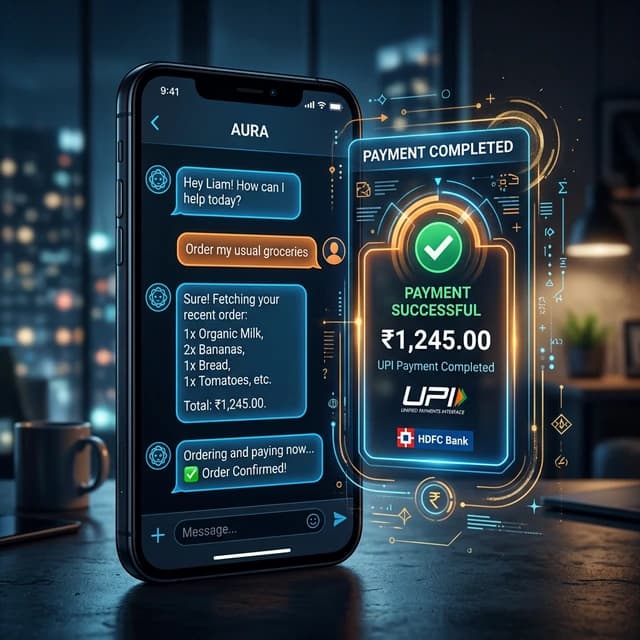

I was watching the India AI Impact Summit coverage and came across the Razorpay and NPCI announcement. On the surface it sounded like another "AI + payments" press release. Then I actually read through what they built and it clicked. This is not marketing speak. Something real landed here.
They have made it so you can tell an AI assistant to order your groceries, and it will just do it. Including paying for it. Without you touching a PIN, scanning a QR code, or opening a separate app. That is the short version. The longer version is more interesting.
What "Agentic Payments" Actually Means
The word "agentic" has been floating around the AI world for a while now. It refers to AI systems that do not just answer questions but actually take actions on your behalf. Tool use, multi-step planning, executing tasks in the real world.
Payments were always the wall. You could have the smartest AI assistant helping you decide what to buy, compare prices, build a grocery list, but the moment money needed to move, you had to step in. Enter your PIN. Approve an OTP. Confirm a payment. The AI was always the navigator, never the driver.
What Razorpay built, in partnership with NPCI, removes that wall.
The idea is simple: authorize the AI once, set spending limits, and let it handle transactions on your behalf within those guardrails. It is built on top of UPI Reserve Pay, which is essentially a mandate-based UPI framework that already exists and is already regulated.
So this is not some experimental sandbox thing. It is real UPI, with real consumer protections, with a new layer on top that lets an AI agent trigger payments.
How do agentic UPI payments process a transaction?
Let me walk through what a typical interaction looks like.
You open Claude and type something like, "Order my usual snacks before the match tonight, keep it under 500 rupees." Claude processes that. It knows from your past orders what "usual snacks" means. It checks Zepto or Swiggy, finds the items, sees they are within budget, and places the order. The payment goes through. You get a confirmation. You never left the chat.
Behind that interaction, here is what is happening technically:
- The AI interprets intent and maps it to a merchant action.
- It checks the user's pre-authorized spending limits for that merchant.
- It calls the merchant API to place the order.
- UPI Reserve Pay executes the payment using the pre-set mandate, no OTP, no PIN prompt.
- The transaction is logged and the user sees a confirmation in the chat.
That fourth step is the critical one. UPI Reserve Pay already handles things like recurring subscriptions, auto-debits for utilities, and mandate-based payments. Razorpay and NPCI have applied the same underlying mechanism to this new use case and wired it into an AI experience.
Why is the consent model critical for agentic payments?
This is the part I think is easy to overlook but is actually the whole story.
The reason giving an AI the ability to spend your money sounds scary is because we assume it means handing over the keys completely. That is not what this is.
Here is how consent works in this system: you go in once, you authorize a merchant (say Zomato), and you set a per-transaction spending limit. Maybe 800 rupees. The AI can now complete transactions at Zomato on your behalf, but only up to 800 rupees per transaction, and only for that merchant. You can revoke that consent at any time.
That is a really thoughtful model. It gives you the convenience without making you feel like you have signed a blank cheque. And because it is sitting on UPI's existing infrastructure, every transaction is auditable, reversible within limits, and covered by the same consumer protection norms that govern all UPI payments.
You still control the outer ring. The AI operates within it.
Why Zomato, Swiggy, and Zepto Make Sense as the Starting Point
This is a smart choice of pilot partners, and not just because they are popular.
These three platforms cover food, grocery, and quick commerce. They are high-frequency, low-consideration purchase categories. When you order lunch or restock protein powder, you are not deliberating for days. The decision window is short. The amounts are predictable. The products are familiar.
This is exactly the kind of commerce where AI friction removal has the highest payoff. You are not asking AI to help you buy a laptop or book a flight. You are asking it to execute a repeating, habitual transaction that you have done dozens of times before.
The AI does not need to be creative here. It needs to be accurate, fast, and invisible. And that is precisely what this setup enables.
Why India Was the Right Country for This to Launch In
This could not have happened anywhere else first, and I mean that technically, not patriotically.
Most countries do not have the infrastructure to do this safely at scale. You need:
- A real-time payment network with mandate support
- Deep digital commerce penetration
- An existing base of UPI-trained consumers who are already comfortable with digital payments
- Regulatory infrastructure that understands and can accommodate consent-based AI transactions
India has all of that. UPI is not just a payments layer, it is a full-stack public infrastructure with features like mandates, recurring payments, and real-time settlement built in. The NPCI already has protocols for automated, pre-authorized debits. Razorpay just needed to build the AI-facing interface on top.
On the consumer side: millions of Indians already tap, scan, or type to pay for groceries and food daily. The behavioral habit is there. The trust in UPI is there. The mobile-first culture is there. Plugging AI into that chain is a much shorter leap than it looks.
How will agentic payments change Indian commerce?
I have been thinking about the phrase "from intent to economic action" that Razorpay used in their announcement. It is a little formal, but it captures something real.
Right now, commerce involves a lot of steps between wanting something and having it. You open an app, you search, you browse, you add to cart, you checkout, you pay, you wait. AI has been slowly eating into some of those steps. Recommendation engines handle search. Auto-fill handles checkout. Saved payment methods reduce friction at payment.
Agentic Payments is the next move in that sequence. The AI does not just assist; it executes. You do not lose control. You just delegate the execution of a clearly bounded task.
The interesting question is where this goes from here. Food and groceries are the easy starting point because the purchases are frequent and small. But the same model, with appropriate consent structures, could extend to bill payments, travel bookings, subscription renewals, or any other category where you have a recurring intent and a predictable amount.
The infrastructure Razorpay and NPCI have built is not category-specific. It is a general framework for AI-driven payments on UPI. The categories they launch with are just the first step.
What does this mean for India's fintech future?
The announcement also signals something about where the serious AI work is happening in India. This was not a hackathon demo. It was a production pilot, announced at a major policy summit, built on top of national payment infrastructure, with real consumer applications from day one.
That says something about how seriously Indian fintech is treating the AI layer. Razorpay has been working steadily on making payments smarter for a while, and this is the most architecturally interesting move they have made yet. NPCI's willingness to build the underlying mandate framework for this use case is equally notable. You do not get that kind of infrastructure cooperation in most markets.
I will be watching how the pilot performs and how quickly it rolls out. If the UX is smooth and the consent model holds up in practice, this has a real shot at becoming normal behavior for a large chunk of Indian smartphone users.
And when that happens, the question "did you pay?" will just mean "did you talk to your AI about it?"
References
- NPCI Official UPI Product Page — UPI infrastructure and mandate support
- RBI Master Direction on Digital Payment Security — Regulatory framework for digital payments in India
- Razorpay Developer Documentation — Technical integration details for payment APIs
Keep Reading
- Implementing the Outbox Pattern with CDC in Microservices — The distributed systems reliability patterns that underpin payment infrastructure like this.
- Google Antigravity: Why I Think It Changes Everything — More thoughts on how agentic AI is reshaping what developers and users can accomplish.
You can sign up for early access to the Agentic Payments pilot at Razorpay's signup page. The pilot currently covers Zomato, Swiggy, and Zepto through Claude.