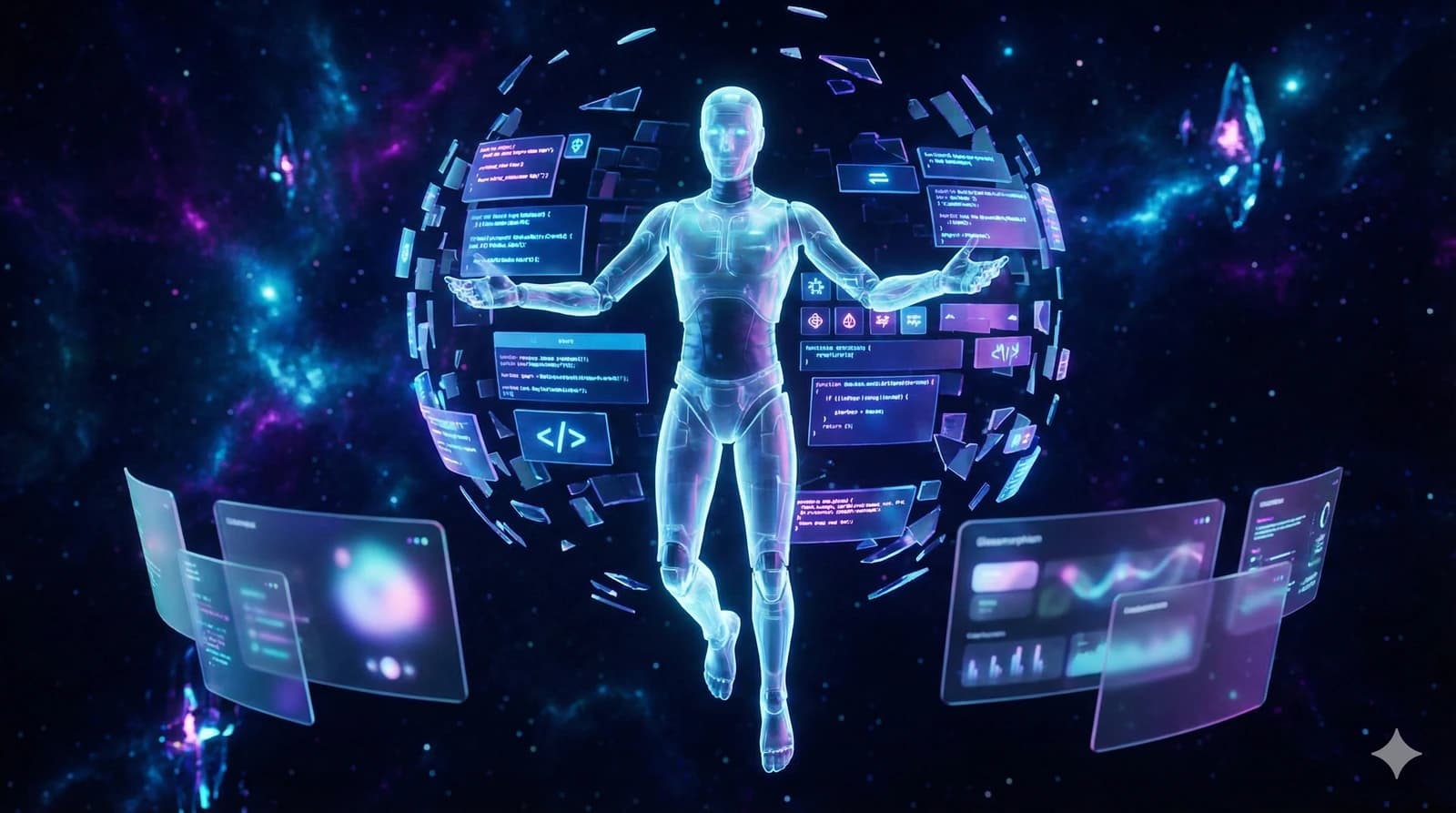

I've been thinking a lot lately about where we're heading as developers. For years, we've been the builders, the ones typing out the syntax, wrestling with semicolons, and debugging obscure errors. But with the launch of Google Antigravity, I feel the ground shifting beneath us.
It's not just another tool. It's a glimpse into a future where we stop being just "coders" and start being true "architects."
How does Google Antigravity go beyond autocomplete?
We've all gotten used to AI assistants. They're great at finishing our sentences or writing a quick utility function. But Antigravity is different. It’s built on Gemini 3 Pro, and it introduces the concept of Agency.
When I look at this, I don't see a chatbot. I see a junior developer who never sleeps. You don't tell it how to write a loop; you tell it, "I need a user authentication system," and it plans, executes, and verifies the whole thing.
What is the "Antigravity" effect on developer productivity?
At first, I'll admit, I felt a twinge of skepticism. If the AI does the heavy lifting, what happens to the joy of coding? The "flow state"?
But then I realized something. The "heavy lifting" is often just... gravity. It's the friction of setting up boilerplates, configuring webpack, or writing the same CRUD endpoints for the hundredth time. Antigravity removes that weight.
It frees me up to think about the product.
- How should this feature feel to the user?
- Does this architecture scale?
- What is the story we are telling with this data?
That is where the real value lies. The AI handles the "how"; I focus on the "why."
How will agentic AI change the developer role?
I believe we are entering an era of Collaborative Intelligence.
In the near future, I won't be opening my IDE to write code from scratch. I'll be opening it to orchestrate a team of AI agents. One agent handles the database schema, another optimizes the frontend performance, and a third writes the integration tests.
My role—our role—will evolve. We will become:
- Reviewers: Ensuring the AI's output aligns with our vision and security standards (thanks to Antigravity's "Artifacts" and transparency, this is actually feasible).
- System Designers: Connecting the dots between complex systems that are too large for a single human mind to hold at once.
- Creative Directors: Pushing the boundaries of what's possible, knowing we have the engine to build it.
Conclusion
Google Antigravity isn't about replacing us. It's about levelling us up. It's giving us the power to build things that were previously impossible for a single developer or a small team.
The gravity of mundane tasks is gone. The only limit now is our imagination.
Let's fly.
For more on the evolution of AI-assisted development, see the Google DeepMind Research, Anthropic's research on AI safety, and GitHub's report on AI in software development.
Keep Reading
- Agentic Payments: What Razorpay and NPCI Just Pulled Off — A concrete example of agentic AI moving from code generation into real-world financial transactions.
- My Thoughts on Vibe Coding — How AI-assisted development feels in practice, from the creative highs to the cleanup reality.