
The first time I inherited an AWS account that someone built entirely by hand, it took me two days just to figure out what was running. No record of why a security group allowed a strange port, no way to copy the setup into a second region, and a quiet fear that touching anything would break the one server that worked. That account is the best argument for Infrastructure as Code I can give you.
This is a beginner guide to Infrastructure as Code: what it actually is, why it matters, the difference between declarative and imperative approaches, the tools worth knowing in 2026, and how to start without overcommitting. It's also the on-ramp to a hands-on series, so by the end you'll know exactly where to go to write your first real template.
What is Infrastructure as Code?
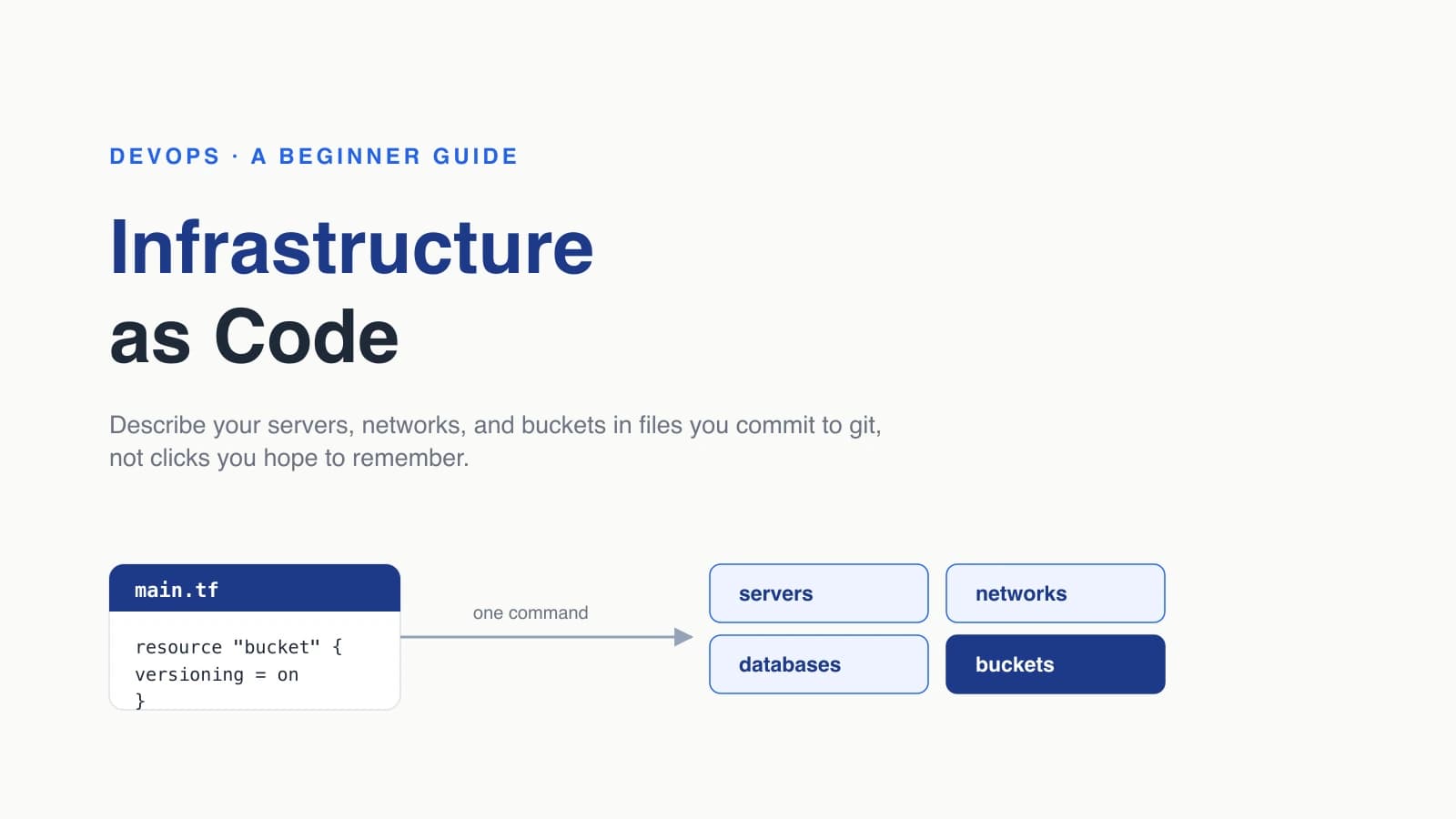
Infrastructure as Code is the practice of defining your infrastructure in machine-readable files instead of setting it up by hand. You describe the servers, networks, databases, and buckets you want in a file, commit it to version control, and hand it to a tool that creates the real resources for you.
The key shift is that your infrastructure stops living only in a cloud console and starts living in a file you can read, review, and replay. That file is the source of truth. When you need the same setup in another region or another account, you run it again instead of trying to remember which boxes you checked.
Think of it the way you already think about application code. You don't rebuild your app by clicking buttons in an IDE and hoping you repeat the same clicks next time. You write code, commit it, and run it. Infrastructure as Code applies that same discipline to the machines your app runs on.
Why does Infrastructure as Code matter?
Infrastructure as Code matters because it turns infrastructure into something you can reproduce, review, and recover, which manual setup never gives you. Once the definition lives in a file, a whole set of problems quietly disappears.
Here's what you actually get:
- Reproducibility. The same file builds the same environment every time, so dev, staging, and prod stay in sync instead of drifting apart.
- Version control. Every change goes through git, so you get history, blame, and code review on your infrastructure, not just your app.
- A safety net for disasters. If a region goes down or an account gets wiped, you rebuild from the files instead of from memory.
- Speed without fear. Spinning up a full environment for a new feature branch becomes one command, not a day of clicking.
- Documentation that can't go stale. The file is the setup, so it always matches reality, unlike a wiki page nobody updated.
I've felt the difference firsthand. The hand-built account took two days to understand. A well-described IaC project takes ten minutes, because the answer to "what is running and why" is right there in the repo.
How does Infrastructure as Code differ from clicking through a console?
It differs in one word: repeatability. Clicking through a console works fine the first time, but it leaves no record of what you did and no reliable way to do it again. Infrastructure as Code captures the what and the how in a file so the result is the same on the hundredth run as the first.
Manual setup, often called ClickOps, has a predictable failure mode. Someone builds an environment, it works, and then six months later nobody remembers the exact settings. A second environment built the same way by hand is never quite identical, and those small differences are where the 2 a.m. incidents come from.
There's also the trust problem. When infrastructure lives only in a console, the only way to know its current state is to go look. With IaC, the file tells you, and a tool can compare the file against reality to catch any drift. That single property, knowing your setup without logging in to check, is worth the upfront effort on its own.
What's the difference between declarative and imperative Infrastructure as Code?
The difference is whether you describe the destination or the directions. Declarative IaC means you state the end result you want and let the tool work out the steps. Imperative IaC means you write the steps yourself, in order.
Most of the popular tools are declarative. You say "I want one S3 bucket with versioning on," and the tool decides whether to create it, update it, or leave it alone. Here's what that looks like in Terraform's language:
resource "aws_s3_bucket" "assets" {
  bucket = "myapp-assets"
}

resource "aws_s3_bucket_versioning" "assets" {
  bucket = aws_s3_bucket.assets.id
  versioning_configuration {
    status = "Enabled"
  }
}The imperative version is a list of commands you run in sequence, and you're responsible for checking the current state yourself:
aws s3api create-bucket --bucket myapp-assets --region us-east-1
aws s3api put-bucket-versioning --bucket myapp-assets \
  --versioning-configuration Status=Enabled
# run this twice and the second create-bucket failsThe big practical win of the declarative style is idempotency. Run a declarative template twice and you still have one bucket, because the tool reconciles the desired state with what already exists. Run the imperative script twice and the second create-bucket errors out. That reconciliation is why declarative tools dominate provisioning, while imperative tools like Ansible shine at configuration tasks where ordered steps make sense.
What are the main Infrastructure as Code tools in 2026?
The main tools split into cloud-native options and multi-cloud options, and the right one depends on how many clouds you touch. Here's how the common choices compare in 2026:
| Tool | Language | Scope | Style |
|---|---|---|---|
| AWS CloudFormation | YAML or JSON | AWS only | Declarative |
| Terraform / OpenTofu | HCL | Multi-cloud | Declarative |
| Pulumi | TypeScript, Python, Go, C# | Multi-cloud | Real code, declarative model |
| AWS CDK | TypeScript, Python, Java | AWS (compiles to CloudFormation) | Code authoring, declarative output |
| Azure Bicep | Bicep DSL | Azure only | Declarative |
| Ansible | YAML | Multi-cloud | Procedural |
A few things worth knowing about the state of these tools. Terraform changed its license to the Business Source License in 2023, which led the community to fork it into OpenTofu under the Linux Foundation, and the two have since diverged with OpenTofu adding features like native state encryption. IBM completed its acquisition of HashiCorp, Terraform's maker, in early 2025, so that ownership question is settled even if the license one isn't. AWS CDK is worth a special mention because it doesn't replace CloudFormation, it compiles down to it, so the CloudFormation concepts you learn still apply underneath.
My honest take for someone starting out: don't agonize over this choice. If you're on AWS, the native tool gets you moving today with zero install, and everything you learn transfers when you later pick up a multi-cloud tool. If you already know you'll work across clouds, Terraform or OpenTofu is the safer long-term bet.
How do you get started with Infrastructure as Code?
You get started by picking one tool, describing one small resource, and running the full create-and-destroy loop once. The mistake is trying to codify an entire existing environment on day one. Start tiny and build the muscle memory first.
A first session that actually teaches you something looks like this:
- Pick the tool that matches your cloud. On AWS, that's CloudFormation. No new account, no extra CLI beyond what you have.
- Describe one resource. An S3 bucket is the classic starting point because it's safe, cheap, and quick to create.
- Commit the file to git. This is the whole point. Your infrastructure now has history.
- Deploy it, then preview a change before applying it. Every serious IaC tool can show you a diff of what will change before it touches anything.
- Tear it down. Knowing you can cleanly destroy what you made is what makes experimenting safe.
If you're on AWS, I've written that exact walkthrough already. Creating your first CloudFormation stack takes you from an empty file to a deployed bucket, through change sets, and into a clean teardown. Once that loop feels natural, running one template across dev, staging, and prod is the next step that makes IaC pay for itself.
What mistakes do teams make when adopting Infrastructure as Code?
The common mistakes all come from treating IaC as a one-time conversion instead of a habit. Each one is avoidable once you've seen it.
Editing in the console after the fact. The fastest way to break IaC is to "just fix it quickly" in the console. Now the file and reality disagree, and the next deploy either fails or undoes your fix. Once a resource is managed by code, change it through the code.
Putting secrets in the files. Infrastructure definitions get committed to git, so a hardcoded password or API key is now in your history forever. Use your cloud's secrets manager and reference it, never paste the secret in.
Building one giant file. A single 2,000-line template that defines everything becomes impossible to change safely. Keep definitions small and focused so a change to one thing can't accidentally take down another.
Skipping the preview. Every good tool shows you a plan before it acts. Teams that skip reading it eventually run a change that replaces a database instead of updating it. Read the diff, every time.
Where should you start with Infrastructure as Code?
Start with whatever cloud you're already on, and start this week. The biggest mistake isn't picking the "wrong" tool, it's waiting for the perfect moment to adopt IaC while your infrastructure keeps growing by hand. Every resource you click into existence today is one more thing you'll have to reverse-engineer later.
Here's the part that took me too long to learn: Infrastructure as Code is a habit, not a project. You don't convert everything in one heroic sprint. You make a rule that new infrastructure goes through code, you bring old infrastructure under management as you touch it, and within a few months the scary hand-built account becomes a repo anyone can read. The tool matters less than the discipline. Pick one, write one small template, and let the habit compound from there.
For deeper reading, see the AWS CloudFormation User Guide, the Terraform documentation, and the OpenTofu project for the open-source fork.
Keep Reading
- How to Create Your First AWS CloudFormation Stack (2026). The hands-on next step: write and deploy your first real IaC template on AWS.
- How to Deploy One CloudFormation Template to Dev, Staging, and Prod. Where IaC starts paying off, running one definition across every environment.
- How to Migrate from Ingress NGINX After Kubernetes Retired It. A migration story that shows why infrastructure in code makes big changes survivable.