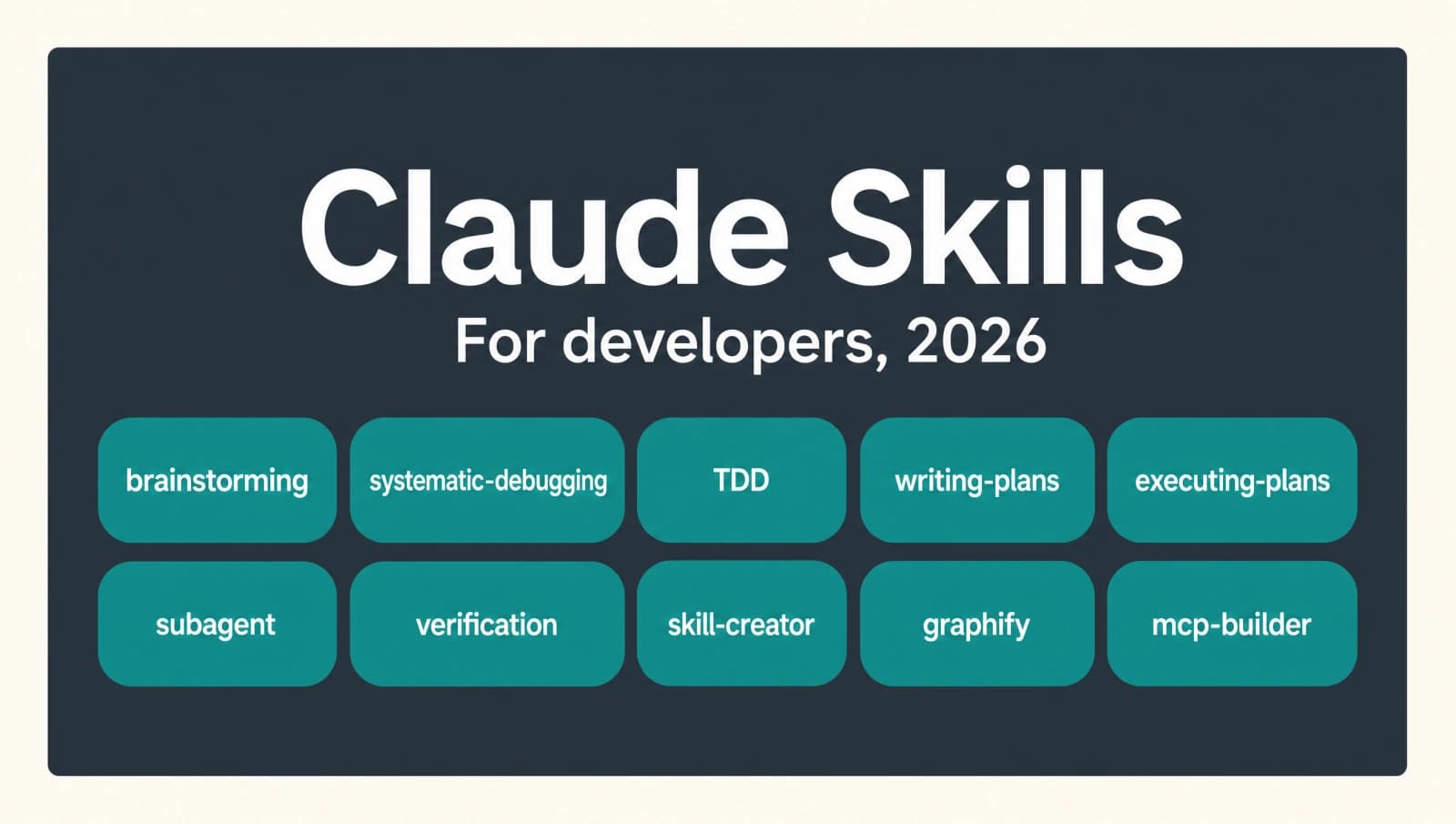

Anthropic shipped Skills in October 2025. A year and a half later, the skill ecosystem is real. anthropics/skills has 141,849 stars. obra/superpowers has 209,283 stars. The open standard is live.
I install a lot of skills. Most do not earn the slot. These ten do. Quick-look format below: name, direct link, what it does, what I use it for. Ranked by impact in real work, with parent-repo star count as a popularity tiebreaker.
What are Claude Skills?
A Claude Skill is a folder with a SKILL.md file that teaches Claude one specific task. When the model sees a task that matches, it loads the skill and follows the playbook inside. The point is making behavior reliable. You write the convention once; every future session follows it.
Skills are generally available across claude.ai, Claude Code, and the Claude API (the API still requires the skills-2025-10-02 beta header).
How do you install Claude Skills?
Three install paths cover everything:
# Path 1: Anthropic official skills (clone into your skills folder)
mkdir -p ~/.claude/skills
cd ~/.claude/skills
git clone --depth 1 https://github.com/anthropics/skills.git anthropic-skills

# Path 2: superpowers plugin (run inside a Claude Code session)
/plugin install superpowers@claude-plugins-official

# Path 3: per-project skills (drop into .claude/skills/ in the repo root)After install, restart your Claude Code session once.
What are the 10 best Claude skills for developers?
Ranked by impact, parent-repo stars listed for transparency.
1. brainstorming
- Skill: obra/superpowers · brainstorming (parent repo 209k stars)
- What it does: before any feature work, runs a structured exploration of intent, requirements, and design. Writes a short design memo. Asks for approval before any code.
- Use it for: every "build X" or "add Y" request. Catches the one design question you forgot to ask.
2. systematic-debugging
- Skill: obra/superpowers · systematic-debugging (209k stars)
- What it does: forces a four-step bug protocol: reproduce deterministically, hypothesize root cause, prove or disprove with the smallest test, fix only the root cause.
- Use it for: every flaky test and every "why is this slow?" investigation. Replaces try-catch reflex with real root-cause work.
3. test-driven-development
- Skill: obra/superpowers · test-driven-development (209k stars)
- What it does: writes the failing test first, runs it, shows the failure, then writes the implementation. Re-runs after each pass.
- Use it for: any new function or feature where correctness matters. Stops Claude from "verifying" by re-reading its own code.
4. writing-plans
- Skill: obra/superpowers · writing-plans (209k stars)
- What it does: turns a vague request into a numbered plan with critical files identified, tradeoffs called out, and explicit checkpoints.
- Use it for: any task that touches 3+ files or crosses a boundary (API, DB, infra). Prevents "looks done but breaks in three places."
5. executing-plans
- Skill: obra/superpowers · executing-plans (209k stars)
- What it does: runs a plan one step at a time in a separate session, with explicit checkpoints between steps.
- Use it for: following up on a writing-plans output. Lets you resume mid-plan after a fix or a context switch.
6. subagent-driven-development
- Skill: obra/superpowers · subagent-driven-development (209k stars)
- What it does: spawns a subagent per independent subtask, runs them in parallel, merges results. Enforces clean handoff contracts.
- Use it for: any task with parallelizable pieces (audit v1 vs v2 API, scan 5 services, compare 3 SDKs). Saves wall time and context budget.
7. verification-before-completion
- Skill: obra/superpowers · verification-before-completion (209k stars)
- What it does: runs the actual app or test suite end-to-end before reporting the task done. Surfaces evidence of what worked and what broke.
- Use it for: the "tests pass but the feature is broken" class of bug. Pair with brainstorming + TDD for the full discipline loop.
8. skill-creator
- Skill: anthropics/skills · skill-creator (parent repo 142k stars)
- What it does: interviews you on trigger language, steps, and references, then writes a new
SKILL.mdin the right shape. - Use it for: every repeatable task you do more than twice a week. The meta-skill that pays for itself the first time.
9. graphify
- Skill: safishamsi/graphify (55k stars)
- What it does: runs an AST pass over your project, identifies god nodes, maps community structure, writes a queryable wiki under
graphify-out/. - Use it for: any repo over 30k lines. Future sessions read the wiki instead of grep-walking the file tree.
10. mcp-builder
- Skill: anthropics/skills · mcp-builder (parent repo 142k stars)
- What it does: scaffolds an MCP server end-to-end (transport choice, tool annotations, auth, deployment hints). Generates a working Spring/Node/Python skeleton.
- Use it for: the first MCP server you build. Replaces the "read 4 docs to get started" ritual with one prompt.
Which Claude skills should you install first?
Install in this order:
- Run
/plugin install superpowers@claude-plugins-officialin Claude Code. Pulls 7 of the 10 skills above. - Clone anthropics/skills into
~/.claude/skills/anthropic-skills/. Gives you skill-creator, mcp-builder, and a wider base library. - Install safishamsi/graphify when your project crosses 30k lines.
- Run skill-creator once. Build a custom skill for the most-repeated task in your current project. Writing one teaches you how to read others.
The thing nobody says out loud: the compounding only kicks in if you actually use them. Skills are habits, not features. Install one. Use it for two weeks. Then install the next.
For more on Claude Skills internals, see the Anthropic engineering deep-dive on agent skills, the Claude Code skills documentation, and the open skills standard at agentskills.io.
Keep Reading
- Claude Skills vs MCP vs Projects. Where skills end and MCP servers begin.
- Claude Code Routines: Async CI Automation Just Became Real. Use skills inside scheduled CI runs.
- Claude Opus 4.7 Release and Migration Guide. The model these skills run on top of.